 Cart
CartWill to Power and the Nature of Intelligence Instructor: Vincent Lê Date & Time: November 16, 23, 30, December 7 09:00-11:30 ET
DESCRIPTION: This Seminar provides an in-depth look at Nietzsche’s infamous but often misunderstood doctrine of “the will to power” by reconstructing how it is presented, developed, and refined across his published works and unpublished notebooks, as well as in contemporary Nietzsche scholarship. Rather than approaching the will to power as a mere historical curiosity or philosophical slogan, we will investigate the internal evolution and complex nuances of the doctrine, paying special attention to how Nietzsche’s own understanding changed over time and how subsequent generations of scholars have interpreted, critiqued, and reinvented his ideas. This approach will allow us to unravel the richness and contradictions embedded in Nietzsche’s thinking, considering the will to power both as an individual psychological force and as a broad metaphysical principle. We learn how the doctrine can still be of use today, not just for interpreting Nietzsche, but for drawing out overlooked critical insights and posing important questions in ongoing philosophical debates. Whether the issue is agency, free will, ethical responsibility, or the future of intelligence, both human and artificial, we will ask what the will to power offers that contemporary frameworks might miss. By reconstructing its trajectory and situating it alongside current debates in philosophy of mind, ethics, and the theory of intelligent agency, the Seminar encourages participants to revisit and reimagine the stakes of Nietzsche’s thought for our own time.
Session 1, Why Will to Power Today?: We begin by showing how Nietzsche’s often-dismissed doctrine of the will to power remains relevant for contemporary philosophical debates. In particular, we contrast Nietzsche’s ideas with Nick Bostrom’s influential theory of intelligent agency, exploring both similarities and important differences that emerge around questions of agency, instrumental power, and fundamental drives.
Readings: Nick Bostrom, “The Superintelligent Will” and “Is the Default Outcome Doom?”, in Superintelligence: Paths, Dangers, Strategies (Oxford: Oxford University Press, 2014), 105–126.
Session 2, The Will to Power in the Published Works: This Session traces the appearance and development of the will to power across Nietzsche’s published writings—from its earliest anticipations to its explicit articulation after Thus Spoke Zarathustra. We explore how Nietzsche presents the will to power as a drive more fundamental than self-preservation, shaping human and possibly all life’s striving for mastery and distinction.
Readings:
Friedrich Nietzsche, “An Attempt at Self-Criticism,” in The Birth of Tragedy and Other Writings (Cambridge: Cambridge University Press, 2007), 3–12.
Friedrich Nietzsche, aphorisms 23, 113, 189, 575, 429, 542, in Dawn: Thoughts on the Presumptions of Morality (Stanford: Stanford University Press, 2011), pp. 21–22, 80–82, 133–134, 281–282, 223–224, 263–266.
Friedrich Nietzsche, “On a Thousand and One Goals” and “Self-Overcoming,” in Thus Spoke Zarathustra: A Book for All and None (Cambridge: Cambridge University Press, 2006), pp. 42–44, 88–90.
Session 3, Interpreting the Will to Power: We examine major scholarly interpretations of the will to power as both a psychological and metaphysical doctrine, before advancing a metaphysical and constitutivist reading: the will to power as a universal, quasi-normative drive at the core of all goal-directed action.
Readings:
Maudemarie Clark and David Dudrick, “Introduction,” in The Soul of Nietzsche’s Beyond Good and Evil (Cambridge: Cambridge University Press, 2012), pp. 1–10.
Tsarina Doyle, “Introduction,” in Nietzsche’s Metaphysics of the Will to Power: The Possibility of Value (Cambridge: Cambridge University Press, 2018), pp. 1–16.
Paul Katsafanas, “Introduction” and “Action’s Second Constitutive Aim: Power,” in Agency and the Foundation of Ethics: Nietzschean Constitutivism (Oxford: Oxford University Press, 2013), pp. 1–5, 147–182.
Session 4, The Will to Power in the Unpublished Notebooks: By comparing Bostrom’s basic drives with Nietzsche’s speculations in his unpublished 1880s notebooks, we explore the possibility that the will to power is a fundamental, universal drive underlying all action. This Session draws out the difference between Bostrom’s “instrumental convergence” and a Nietzschean model in which power—expressed as intelligence, creativity, and resourcefulness—may be an ultimate end. We also discuss Nietzsche’s challenge to the idea of self-preservation as the most basic drive.
Readings: Friedrich Nietzsche, The Will to Power: Selections from the Notebooks of the 1880s, ed. R. Kevin Hill, trans. R. Kevin Hill and Michael A. Scarpitti (London: Penguin Books, 2017), sections 666–715, pp. 374–406.
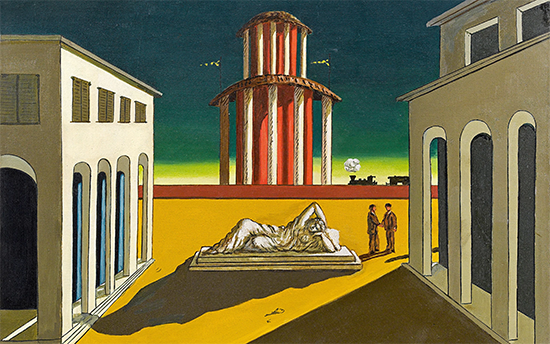
IMAGE: Giorgio de Chirico, Piazza d’Italia, 1935
To see The New Centre Refund Policy CLICK HERE.
To see The New Centre Refund Policy CLICK HERE.