 Cart
CartFrom Magic to Media:
A Hermetic Genealogy of Optical and Communication Technologies Instructor: Farshid KazemiProgram: Transdiciplinary Studies, Intercentric Art & Curatorial Practice, Critical Philosophy, Information Architecture & Intelligence DesignCredit(s): 1Date: August 15, 22, 29, September 5Time: 14:00-16:30 ET
DESCRIPTION: This Seminar examines the genealogy (in a Nietzschean sense) of technical and optical media—from pre-cinema technologies through film and beyond—through its occulted roots in Hermeticism, magic, and alchemy. With the rise of artificial intelligence, virtual reality, and artificially constructed images of illusion and deception, it is becoming increasingly imperative to trace the history of our technologically mediated realities to the little-known genealogies of shamanic performance, ritual, and Hermetic magic, and to question the cultural, philosophical, and political significance this knowledge holds for our time. The intersection of magic, technology, and art—especially occult technologies such as alchemy and talismans—reveals the predecessors of much of what we consider technical media and optical technologies: photography, film, the internet, social media, and AI.
To provide a sample of what we cover: we examine Giovanni Fontana’s influential treatise Illustrated and Encrypted Book of War Instruments, written around 1420 CE, an illustrated book of military instruments, optical media, and automata. This treatise contains one of the first ever depictions of an early version of the magic lantern or lanterna magica in Europe. We trace how such optical devices and automata as military technologies appear in the literature of Islamicate or Arabic Hermetica by excavating its earliest sources in the little-studied Pseudo-Aristotelian Hermetica, much of which was influenced by Harranian astral magic. We consider figures such as the enigmatic Balinus or pseudo-Apollonius of Tyana, a disciple of the legendary Hermes Trismegistus, called in the sources “the lord of talismans” (sahib-i tilismat). In these texts, Aristotle or Balinus creates automata called “talismans” (tilismat) for the purpose of helping Alexander conjure illusions to deceive and frighten his enemies in battle—precisely the function of the optical device illustrated in Fontana’s manuscript, considered an early version of the magic lantern. The early magic lantern device described in Fontana’s book is a talisman (Arabic: tilism, Persian: telesm) with its genealogy in the literature of Hermetica transmitted via Arabic and Persian sources into Europe. In this way, the Seminar contributes to discourses on decoloniality by decolonizing the largely Eurocentric narratives of the history of media technologies.
We also consider how the very technological devices we use and hold in our hands today—smartphones, AGIs such as ChatGPT—may be understood as talismanic media rooted in Hermetic magic, possessing different operationalities from their current forms and uses under late capitalist and neoliberal regimes. What is at stake today and for the future is who controls and wields these powerful talismanic media. We think through these issues with theorists and philosophers including Ernst Bloch, Yuk Hui, Gilbert Simondon, Siegfried Zielinski, Vilém Flusser, Ernst Kapp, and Friedrich Kittler, Perso-Islamicate philosophers such as Suhrawardi and Ahsai, and the writings of early avant-garde movements such as The Great Game and Surrealism.
Session 1: Introduction / A Hermetic genealogy of technical media, decolonizing Eurocentric narratives of media history, talismanic media and Hermetic magic, late capitalism and neoliberal regimes, who controls talismanic media
Session 2: Archaeoapocalypse / A Hermetic archaeology of technical media, Foucault’s Archaeology of Knowledge and media archaeology, archaeoapocalypse as alternative methodology, the motif of discovery of hidden and arcane knowledge
Session 3: Media as Talismans / Theorizing talismanic magic, Fontana’s Illustrated and Encrypted Book of War Instruments (1420 CE), the lanterna magica, Pseudo-Aristotelian Hermetica, Harranian astral magic, Perso-Islamicate sources, optical media’s magical heritage through to cinema
Session 4: Cinematic Cosmos / Islamicate philosophy and cinema theory, decolonizing Eurocentric media and film discourse, the concept of hūrqalyā, Suhrawardī and the Illuminationist school, Shaykh Aḥmad al-Aḥsāʾī and the Shaykhi school, the world of images (ʿālam al-mithāl), correspondence between cosmic and cinematic ontology
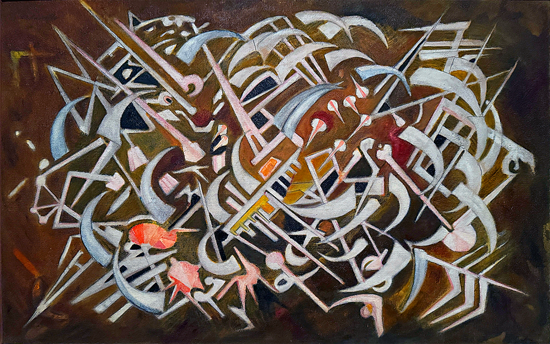
IMAGE: Vera Dg, Calligraphy Abstract Expressionism, 2017
To see The New Centre Refund Policy CLICK HERE.
To see The New Centre Refund Policy CLICK HERE.