 Cart
CartNecrophilanthropy:
Nonprofit Killers and the Carceral State Instructor: Emily Rose Apter & Charles de AgustinProgram: Sociopolitical Thought, Critical Philosophy, Intercentric Art & Curatorial PracticeCredit(s): 1Date: Sept 27, October 4, 11, 18Time: 14:00-16:30 ET
DESCRIPTION:Indebted to the benevolence of grantmakers and one-percenters, liberal 501(c)(3) organizations have consistently absorbed, defanged, and profited from radical movements for social transformation over the past forty years. From a workers’ perspective, the web of public and private interests that constitute the nonprofit industrial complex (NPIC) might be experienced as constant negotiations between domination and subjugation, exploitation and genuine pleasure. “Necrophilanthropy,” the neologism at the heart of this Seminar, invokes necropolitics and necrophilia to probe deeper into the seductive death drive of capital.
The first half of the Seminar surveys the NPIC’s structural underpinnings through lecture and discussion, from the late-nineteenth-century “scientific charity” movement through the fall of the welfare state and rise of mass incarceration. We then narrow in on art and culture to historicize the 1990s rise of “social practice,” examine how artists have been instrumentalized to beautify the carceral system, look at the contemporary wave of (arts) nonprofit labor struggle, and the US “nonprofit killer” bill—planning to revoke nonprofit status of organizations deemed to be “terrorist supporting” with no recourse, targeting even the most mild Palestine solidarity. These factors and more have brought the liberal 501(c)(3) to its current existential crossroads.
The second half of the Seminar will be responsive to the particular needs and interests of participants. Collaborative student presentations may use case studies, power mapping, and lived experiences to consider what it means to evade mechanisms of elite capture. The Seminar will culminate with individual final works in the form of an essay, presentation, direct action, or workshopping a speculative organization. Themes of death and seduction will remain front and center as we strive toward a range of artistic, administrative, and agitational strategies toward the question of how cultural production, within or against the NPIC, can be materially useful to revolutionary movement work today.
We will study materials by artists and thinkers like Robert Allen, Chloë Bass, Ruth Wilson Gilmore, Larne Abse Gogarty, Jarrod Shanahan & Zhandarka Kurti, Olúfẹ́mi O. Táíwò, and Jeniffer Wolch. Readings and other assignments will be adjusted based on collective capacity. Artists and cultural workers—salariat or precariat, waged or unwaged—are particularly encouraged to register, though we are eager to study with folks from other sectors who are interested in the broader themes.
Week 1. Pre-reading: Mbembe’s “Necropolitics” chapter 3 (2019), Rodríguez’s “The political logic of the non-profit industrial complex” (2016) (also: introduction to Kurti/Shanahan’s “Skyscraper Jails,” Shanahan’s “Explosive Elements Beneath the Surface of the City of New York”). Review syllabus, requirements, deadlines. Lecture: intro to necropolitics & nonprofit industrial complex, NPIC early history.
Week 2. Pre-reading: Allen’s “Black Awakening in Capitalist America” excerpt (1969), Gilmore’s “In the shadow of the shadow state” (2016), introduction to Gogarty’s “Usable Pasts” (2022), Petrossiants / Arts Workers Inquiry zine excerpt (2025). NPIC history continued 1930s-today via art/culture. Film discussion.
Week 3. Student text presentations (anti-work horizons, ideal alternatives, power research, organizing methods).
Week 4. Necrophilanthropy reflections, flexible for leftover reading/lecture discussions, briefly share final works.
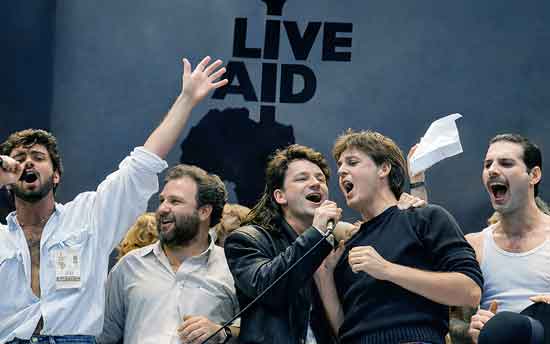
IMAGE: Live Aid Concert, 1984
To see The New Centre Refund Policy CLICK HERE.
To see The New Centre Refund Policy CLICK HERE.