 Cart
CartJerusalem Syndrome:
Symbolic overload & the architecture of belief Instructor: Alicia Kamien KazhdanProgram: Transdiciplinary StudiesDate: April 1, April 8Time: 09:00AM – 12:00PM ET
DESCRIPTION: This Roundtable investigates Jerusalem Syndrome, a rare psychoreligious phenomenon in which an individual experiences intense religiously themed ideas or delusions triggered by a visit to the city of Jerusalem, as a framework for examining symbolic overload, spiritual cognition, and the embodied architectures of belief. Instead of interpreting the syndrome as pathology, it is approached as a heuristic for understanding how sacred and symbolically charged environments can overwhelm perceptual and cognitive boundaries, producing rupture, transcendence, or revelation. Drawing from neurotheology, affect theory, cultural psychiatry, and spatial phenomenology, participants will explore how neural, architectural, and affective systems converge to generate sacred experience. The Roundtable aligns with The New Centre’s commitment to collaborative, research-based, and transdisciplinary inquiry, linking cognitive science, philosophy, and spatial theory through experimental collective learning.
PROCESS: One week before Session One, participants receive a lecture draft, reading list, and case materials (Bar-El, Witztum and Kalian, Bachelard, Pallasmaa, Ahmed, Newberg, Persinger, McNamara, Burke). They also begin Symbol Diaries or Affective Fieldnotes, documenting encounters with symbolically or emotionally saturated spaces to prepare their interventions.
SESSION ONE: Symbolic Overload and the Architecture of Belief (3 hours). A 60-minute lecture examines the neurocognitive and spatial mechanics of symbolic excess through case studies of Jerusalem, Paris, and Florence, cities historically and affectively charged to the point of psychic saturation. Jerusalem Syndrome and its sister syndromes, Stendhal and Paris, are presented within a framework that connects architecture, affect, and cognition, revealing how sacred and aesthetic environments function as symbolic amplifiers that exceed the brain’s integrative capacity. Each participant then presents a 10-minute critical response connecting the lecture and readings to their research or creative practice. The session concludes with a group dialogue on how affect, architecture, and cognition converge to produce states of belief, rupture, and transformation.
SESSION TWO: Neurospiritual Futures: Collective Inquiry and Reflective Practices (2.5–3 hours). The session begins with introductory framing remarks and a guest presentation by Suhaila Abu Hadba Mounayer, a Jerusalem-born artist whose work on church architecture, wartime tonality, and spatial memory introduces an embodied perspective on sacred density, destruction, and resonance. Participants then deliver revised 10-minute reflections based on their Symbol Diaries and Affective Fieldnotes, connecting personal observations with theoretical framing to trace how encounters with symbolically charged environments reshape understandings of belief, perception, and space. The session ends with a full-group discussion and collaborative synthesis, transforming insights into short texts, conceptual diagrams, or symbolic mappings that articulate emergent frameworks of spatial affect, symbolic overload, and neural plasticity.
ASSIGNMENTS: 1. Group Manifesto: A collective statement articulating shared insights on symbolic overload, faith, and perception. 2. Conceptual Diagram or Schema: A visual mapping of relations between space, cognition, and belief within the Triple Helix framework of Nature, Technology, and Society. 3. Roundtable Video (5–7 min): Edited highlights for The New Centre’s public archive. 4. Individual Reflection: A one-page text explaining how the Roundtable reframed each participant’s approach to transdisciplinary or research-based practice.
OPTIONAL PRACTICES: Case analysis of Jerusalem, Stendhal, and Paris Syndromes; symbolic density mapping through psychogeographic or diagrammatic tools; affective fieldnotes integrating spatial phenomenology and affect theory; and a Symbols Diary that documents images, texts, or experiences exerting symbolic pressure or affective charge.
EXPECTED OUTCOMES: Shared theoretical and methodological frameworks for studying sacred and symbolic environments; a collective publication or zine integrating text, diagrams, and audiovisual documentation; and contributions to The New Centre’s pedagogical model that emphasizes mutual development and collaborative research outputs.
READING LIST: Bar-El, Y. et al. (2000). Jerusalem Syndrome. The British Journal of Psychiatry, 176(1), 86–90; Witztum, E. and Kalian, M. (2016). Jerusalem Syndrome and Paris Syndrome: Two Extraordinary Disorders. Oxford University Press; Newberg, A., d’Aquili, E. and Rause, V. (2001). Why God Won’t Go Away: Brain Science and the Biology of Belief. Ballantine Books; Persinger, M. A. (2001). The Neuropsychiatry of Paranormal Experiences. Journal of Neuropsychiatry and Clinical Neurosciences, 13(4), 515–524; McNamara, P. (2022). The Cognitive Neuroscience of Religious Experience. Cambridge University Press; Bachelard, G. (1994). The Poetics of Space. Beacon Press; Pallasmaa, J. (2012). The Eyes of the Skin: Architecture and the Senses. Wiley; Ahmed, S. (2004). The Cultural Politics of Emotion. Routledge; Burke, E. (1757). A Philosophical Enquiry into the Origin of Our Ideas of the Sublime and Beautiful.
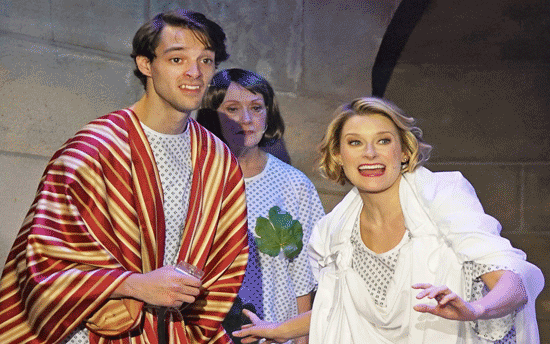
IMAGE: Carol Rosegg, The Jerusalem Syndrome, Off-Broadway production, 2023
Alicia Kamien Kazhdan is an artist, curator, and researcher whose work investigates the intersections of symbolic systems, spiritual cognition, and human behavior. Her current research focuses on site-specific psychological phenomena, particularly Jerusalem Syndrome, approached through the frameworks of neurotheology, affect theory, and cultural psychiatry. Her forthcoming article on the topic will appear in the Cambridge Journal of Human Behavior. Kazhdan studied Cognitive Neuroscience and Art History at New York University, with additional training at IRCAM in Paris and the Musrara School of Art and Society in Jerusalem. She has taught and developed curriculum for MEET (Middle East Entrepreneurs of Tomorrow), an MIT-affiliated initiative fostering cross-cultural collaboration through technology and design. She curated the two-part exhibition Angels of Sabotage (Parterre Projects, 2024; Lifshitz Foundation, 2025), which explored rupture as revelation and sabotage as spiritual and aesthetic method. Her research has been supported by Cold Spring Harbor Laboratory, where she was a Research Fellow in June 2025, and by the Outset Contemporary Art Fund. She has presented her work at Clown Show Books in New York, the Architectural Association in London, and other experimental and academic venues.
To see The New Centre Refund Policy CLICK HERE.