 Cart
CartUnderstanding Memetics Instructor: Arina AtikDate: May 29, June 12Time: 9 am ET
DESCRIPTION: This roundtable proposes a Critical Philosophy of Polymodal Discourse, taking memetics not as a subsidiary internet studies phenomenon but as an epistemological framework for analyzing contemporary cultural production. The capacity of memes to destabilize boundaries between aesthetic practice, philosophical intervention, and collective psychic individuation is what makes them worthy of academic research. Memesis offers critical analysis of memes without translating them into the sterilized language of institutions, and without fully descending into internet jargon. Falling constantly into the abyss between scientific and artistic communication, memes embody mixed media as artifacts of folk vernacular culture. Their participatory affordance is achieved through polymodal discursive nature; the interdisciplinarity of memetic communication renders it nearly invisible to monomodal discourses, demanding new synthetic discursive instruments.
Memesis occupies the space between institutions and the dispersed fragmentation of memes across the internet, and raises the question of a possible future institutionalization of memes within philosophy, art, and critical thinking. Long relegated to low genre by critics, memes are treated here as serious epistemic objects.
Moving beyond Dawkins’ original biological metaphor, the course develops a Laruellean non-memetics while simultaneously employing Simondonian process ontology to map memes’ metastable becoming. We examine how meme logic performs Laruelle’s principle of philo-fiction: just as non-philosophy clones philosophical concepts to expose their limits, memes clone cultural forms (academic discourse, political rhetoric, religious iconography) to render them operationally useless while paradoxically amplifying their circulation. The Laruelle-Simondon dialectic offers participants both a critical weapon against reductive interpretations and a constructive framework for studying meme ontogeny.
Session 1: Memes as Philosophical Practice
This session constructs a speculative genealogy of memes as vehicles for philosophical intervention, beginning with Kierkegaard’s ironist as a subject in perpetual negation, whose contemporary avatar is the dank meme enacting what Hegel feared as infinite absolute negativity. We map the memetic potential of Chan koans, where mimetic illusion demonstrates the illusory nature of reality, and examine liberation through absurdity from Dadaist anti-art to Surrealist Twitter bots, contrasting Deleuze’s vision of humor as resistance with Baudrillard’s silent majorities.
Building on this genealogy, we introduce Laruelle’s non-philosophy to radically reconfigure the meme’s epistemic status. Where traditional philosophy seeks to interpret memes through established frameworks, non-philosophy forces us to confront memes as already-theorized objects that resist philosophical colonization. The meme’s viral persistence and resistance to hermeneutic saturation mirror Laruelle’s determination-in-the-last-instance: memes operate through a radical immanence that precedes and exceeds philosophical capture. We develop a structural typology of irony’s gradations — the stable signifiers of ironic memes, the deadpan abyss of post-irony, and meta-irony’s self-canceling signifiers. We also analyze the meme’s infiltration of subjectivity through Bourdieu’s habitus, reframed for 4chan’s lurker class, whose internalized meme-grammars function as digital doxa.
Session 2: Memetic Individuation and Polymodal Translation
This session theorizes the meme’s ontology through a tripartite schema: the Platonic eidos (Wojak as sadness-in-itself), genre-families and clusters (templates and their modifications), and singular deployments as instances. We explore the universal nature of memes where Loss.jpg crosses cultural thresholds, and examine polymodality through video memes (GIFs as Bergsonian durée compressed into loops), audio memes (samples as acoustic punctuation), and behavioral memes (TikTok challenges as Foucauldian technologies of the self).
Simondon’s theory of individuation replaces static classifications with a processual account of meme-becoming. His concept of the preindividual (that realm of potentials preceding form) describes the metastable state of a meme-template before actualization. The Wojak template exists in a preindividual state of pure affective potential, what we call meme-matter, until individuated through specific deployments as incel icon, leftist critique, or existential cipher. We develop a Simondonian reading of meme propagation as transduction, the process by which a structure reorganizes itself by propagating through a field of potentials. This explains why successful memes exhibit metastable virulence: their capacity to maintain identity while continuously differing. Platform algorithms are analyzed as meme-physical environments that modulate individuation.
Reading List
Søren Kierkegaard, On the Concept of Irony with Continual Reference to Socrates (1841)
Jean Baudrillard, “The Implosion of Meaning in the Media,” from In the Shadow of the Silent Majorities (1983)
François Laruelle, “Philo-Fiction,” from Philosophie non-standard (2010), trans. Jeremy R. Smith
François Laruelle, “On the Determination in the Last Instance,” from Le principe de minorité (1981), trans. Jeremy R. Smith
Michel Foucault, “Technologies of the Self,” from Technologies of the Self: A Seminar with Michel Foucault (1988)
Gilles Deleuze, “Humor, Irony and The Law” (1967)
Pierre Bourdieu, “Structures and The Habitus,” from Outline of a Theory of Practice (1977)
Henri Bergson, “The Multiplicity of Conscious States; The Idea of Duration,” from Time and Free Will (2001)
Gilbert Simondon, “Collective Individuation and the Foundations of the Transindividual,” from Individuation in Light of Notions of Form and Information (2005)
Seong-Young Her, “Metamemetics,” from Critical Meme Reader III (2024)
Seong-Young Her, Postnaturalism (2020)
Phil Wilkinson, “Disassembly and Reassembly: Theorizing a Meme-Rhizome,” from Critical Meme Reader III (2024)
Nate Sloan, “Beyond Based and Cringe” (2021)
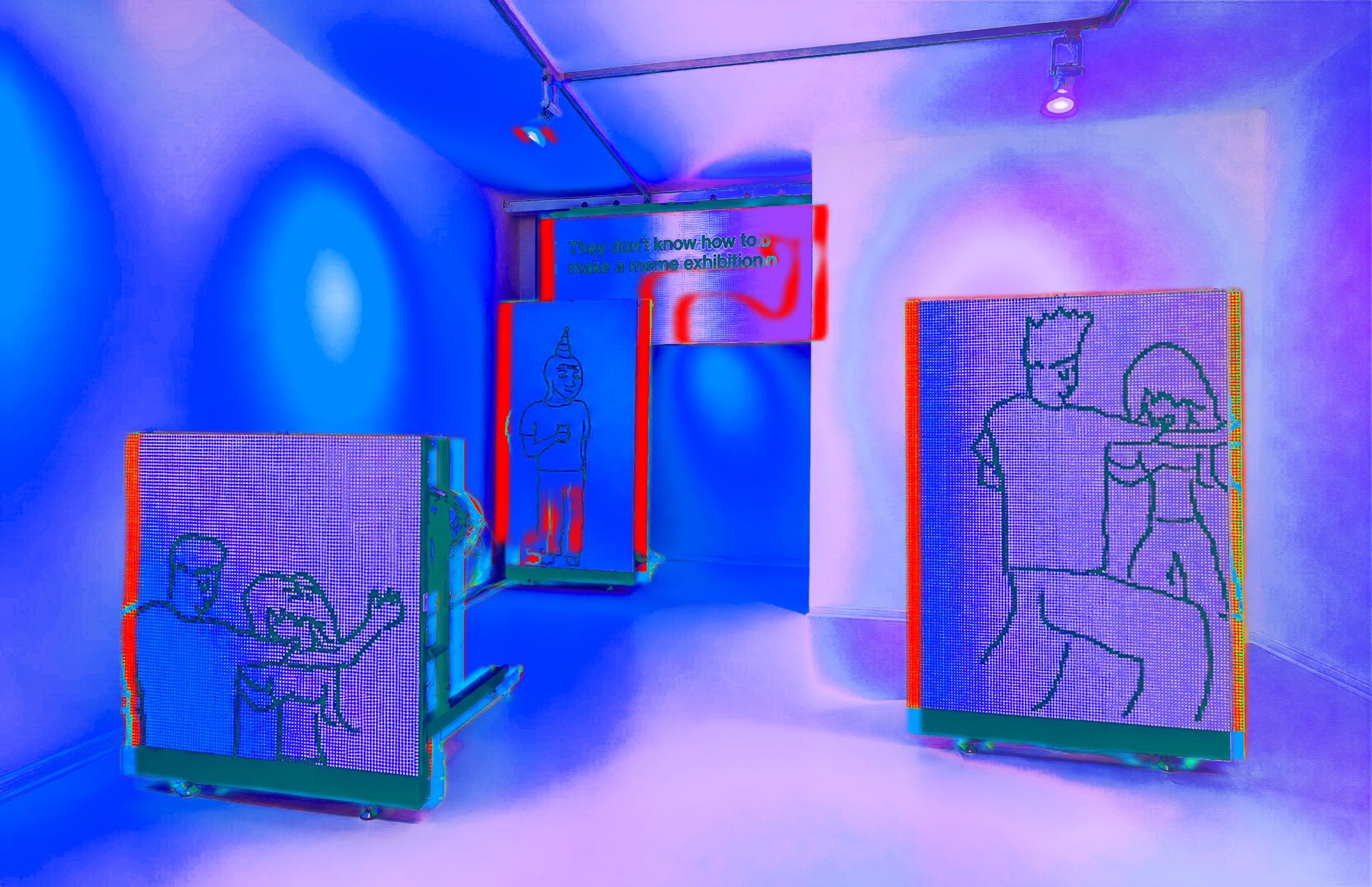
IMAGE: The Party, Cem A. 2021.
To see The New Centre Refund Policy CLICK HERE.
To see The New Centre Refund Policy CLICK HERE.