 Cart
CartTechnological History of Fiction Instructor: Pavel ArsenevProgram: WorkshopCredit(s): 1Date: July 17, 24, 31 and August 7thTime: 14:00-16:30 ET
DESCRIPTION: What if fiction was never opposed to science, but rather its secret double? Russian Formalism was the first declarative attempt at a “scientific” study of literature: an attempt to map the consecutive evolution of “literary facts” and even to unlock the secret engine of prose as if fiction could be diagrammed like a machine. But this initial inspiration by both evolutionism and thermodynamic physics alike produced an unexpected censorship: in defending the autonomy of its object, theory forbade any further “external” explanation and banned contact with parallel domains (science, media, technology). The laboratory became a cell. We want to dismantle the limitations of this era of “military formalism,” the era when literary studies, fighting for autonomy like other scientific disciplines, fortified themselves behind disciplinary walls. Instead, we will trace a radical genealogy of how different literary techniques were infiltrated by scientific experiments and media practices.
From the 19th century’s first “distant approximations” between narrative and empirical science to the latest research at the crossroads of media, technology, and the humanities, we will explore how fiction borrows not just metaphors but instruments, how storytelling becomes a technology of knowing. The microscope and the novel were born of the same desire: to see closer, deeper, otherwise. To view the histories of literature and science as parallel or even entangled is to disrupt the old academic catechism: the familiar division in literary studies between 19th-century realism and 20th-century modernism, conveniently distributed between the autumn and spring semesters, between a passion for representation and a fascination with the surface, between literature as a window into the social world and a self-constructed instrument devoted to language.
We will instead look at fiction as a continuous experiment, where the immanent logic of writing combines with attention to parallel domains: science in the 19th century, technology in the 20th. In fact, realism itself, as an attitude towards (photo)mechanical objectivity, owed much to science and technology. Similarly, the initially strange predication of the novel as an experimental enterprise would subsequently lose its connection with the physiological laboratory and become more or less a mandatory program for modernist literature. Rewriting this history means that literature, whether realist or modernist, was never autonomous but always plugged into the scientific and technical infrastructures of its time, being at the same time not a reflection of acquired knowledge, but one of the tools for constructing possible worlds, testing epistemic limits, and exposing the aesthetic fictions that science itself cannot escape. If fiction has always been an experiment, the question always looms on our horizon: what, exactly, are we testing now?
Session 1: (Media) Archaeology of Communication and the Epistemology of Fiction / The archaeology of knowledge as prolonged and radicalized by media archaeology of communication and theories of discursive infrastructures. The joint history of literature and science. Goethe as poet and naturalist. Scientific rationality and the “culture of the senses.” Balzac and the inheritance of natural history in fiction. Social facts and the aesthetics of positivism. Mistranslations and the foundation of Russian literary positivism.
Readings: Honoré de Balzac. Introductions to The Human Comedy // Project Gutenberg, Kittler, F. Discourse Networks 1800–1900. Trans. M. Metteer and C. Cullens. Stanford: Stanford UP, 1990.
Session 2: Experiment and Fiction. Parallelism of Contemporary Science and Art / A parallel analysis of the “vision” of contemporary science and art, on both pictorial and conceptual levels. Photography and psychophysiology as conditions of modernist art. The experimental measurement of sensations (light, color, sound) and the birth of Impressionism. Literary semiosis in comparison and contrast with scientific semiosis. “Laboratories of ideas,” “thought experiments,” and laboratory knowledge. The institutional and technical setting of the laboratory vs. “the man at the writing desk.” Reference to physical facts, the genre of the hypothesis, and the use of signs in narrative fiction. The “propaganda of scientific facts” in Russian radical criticism of the 1860s. Transfer of the laboratory protocol into the “experimental novel.” Modernist semiosis without reference.
Readings: Vitz, P., and A. Glimcher. Modern Art and Modern Science: The Parallel Analysis of Vision. New York: Praeger, 1984.
Baudelaire, Ch. “The Salon of 1859: The Modern Public and Photography,” in Modern Art and Modernism. Routledge, 1982.
Zola, É. “The Experimental Novel” (1893), in The Experimental Novel and Other Essays. Trans. B. Sherman. New York: Haskell House, 1964. Moser, W. “Experiment and Fiction,” in Literature and Science as Modes of Expression, pp. 61–80.
Session 3: Psychophysiological Aesthetics and the Origins of Formalism / Physiological experimentation and the “destruction of aesthetics” in Russian radical thought. Aesthetics as a “branch of applied physiology” (Nietzsche). “Physiological aesthetics”: from metaphors to experimental settings. The materiality of language as an object of experimentation. Psychophysics and the psychophysiology of perception (auditory sensations). Experimental phonetics and laboratory equipment in avant-garde poetry. Formalism vs. impressionistic criticism and the “parallel series.” Experimental psychology in cultural history. The positive science of literature in the history of ideas (early 20th century). Defamiliarization of Formalism.
Readings: Valéry, P. “On the Literary Technics” [1889], in The Art of Poetry. Trans. D. Foliot. Princeton: Princeton UP, 1989, pp. 314–323. Tolstoy, L. What Is Art? Trans. R. Pevear and L. Volokhonsky. Penguin Classics, 1996. Shklovsky, V. “Art as Technique” (aka “Art as Device”), in Literary Theory: An Anthology, ed. J. Rivkin and M. Ryan. 2nd ed. Blackwell, 2004, pp. 3–24.
Session 4: The Mechanization of Grammar and Psychoengineering in Fiction / The “revolution of language” as linguistic technology and the “factory of literature.” Word invention and word building. The poetic avant-garde and the new media of the time. The material and technical basis for the “mechanization of grammar.” Soviet programs of literary industrialization and collectivization. The industrial avant-garde and the history of psychotechnics.
Readings: Platonov, A. “Factory of Literature.” Trans. A. Kalashyan, from Oktyabr 10 (1991): 195–202. Tretiakov, S. “The New Leo Tolstoy,” in October 118 (Fall 2006): 45–50. Stephens, P. The Poetics of Information Overload: From Gertrude Stein to Conceptual Writing. Minneapolis: University of Minnesota Press, 2015.
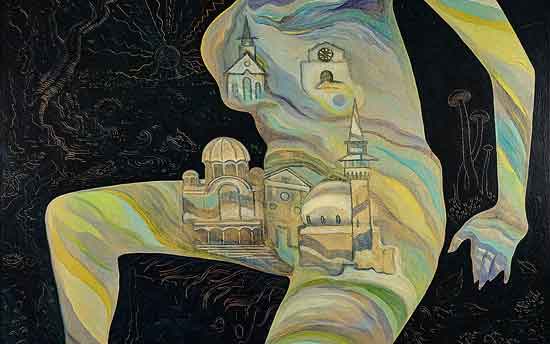
IMAGE: Hortensia Mi Kafchin, Religions on the Genitals
To see The New Centre Refund Policy CLICK HERE.
To see The New Centre Refund Policy CLICK HERE.