 Cart
CartAccelerationism and Revolution in Russia Instructor: Marina Simakova Date & Time: October 3, 10, 17, 24 09:00-11:30 ET
DESCRIPTION: Vladimir Lenin once said: “I’m certainly not radical enough. One can never be radical enough, that is, one must always try to be as radical as reality itself.” Realities indeed circumscribe the very domains of our struggles, whether social or ontological. In other words, our thought and action are always rooted in their structures, and this disposition of the subject to radicate in reality is exactly what defines it as radical. In the history of modern knowledge, the subject’s disposition to be rooted in reality usually appears in its epistemic forms, notably different versions of determinism. In political history, this disposition usually becomes the matter of resistance and contestation. In this vein, Lenin’s saying could be read in the following way: “Reality acts upon us faster than we can act upon it, thus our task is to accelerate human agency—to enhance our capacity to enroot things and transform reality together with ourselves. Being radical, therefore, is to constantly radicalize oneself.”
But what does it mean, exactly, to be radical and to radicalize oneself? What kind of subjects does this task presume at specific historical conjunctures? This Seminar explores these questions by taking a historical journey across pre-Soviet and Soviet political experiences, focusing on various manifestations of political radicalism. Moving away from the dominant view of radicalism as merely an extreme left or right ideology, this Seminar suggests attending to our political selves and focuses on radical subjectivities. In particular, we will trace how forms of Soviet Accelerationism—the drive to intensify and harness the forces of social and technological transformation—shaped the emergence of new radical subjects and strategies throughout Russian and Soviet history. We will study four distinct radical subjects, each representing specific movements, intellectual projects, or political practices, from late 19th-century anarchist populism to post-revolutionary artistic experiments.
The Seminar sits at the intersection of intellectual history, political philosophy, and cultural history, drawing approaches from each discipline. Each Session offers a contextual introduction and a reading of the political text(s), from pamphlets and manifestos to philosophical treatises, allowing us to study both historical and conceptual aspects of radical subjectivities in their formation.
The Seminar’s argumentative framework proposes that radicalism, when viewed through the lens of subjectivity formation, implies a fusion of everyday life and political existence—to the point where they become inseparable. In this view, the individual herself becomes a site of political struggle. Radical subjects are neither ideal types nor conceptual characters; they are lived subjects who can guide us through the political imaginaries and historical landscape of Russian and Soviet radicalism.
Session 1, An Ascetic or a Terrorist? The People’s Will and Populist Voluntarism: The Seminar explores the practices and ideas of the People’s Will, a political organization in late 19th-century Russia. Operating secretly, this group embraced direct action tactics, eventually radicalizing its methods to the point of political terror. This session examines how such radicalization occurred, focusing on the formation of revolutionary subjectivity that blended political conviction with religious forms of self-awareness.
Session 2, An Intellectual or a Militant? Professional Revolutionaries and Russian Social Democracy:This Session further develops a conversation on revolutionary organizations, now moving to the Russian Social Democrats. It introduces and deciphers the central figure of the movement—the professional revolutionary. The Session examines the dual mission of the professional revolutionary, who must simultaneously propagate ideas and agitate people, acting as a writer or theorist and as a militant at the same time.
Session 3, A Worker or an Artist? Proletkult and Cultural Politics of the Post-Revolutionary Avant-garde: This Session turns to the history of ideas often grouped under the problematic umbrella term “Russian cosmism.” With this cosmist context in mind, we focus on Evald Ilyenkov’s treaty titled Cosmology of the Spirit. Excavating political project from the depths of he philosophical argument, the session explores a striking version of radical subjectivity: the materialist who is prepared to embrace collective self-sacrifice for the salvation of matter.
Session 4, A Hero or a Sacrifice? Radical Cosmologies and the Science of Immortality: The Seminar concludes with Russian cosmism, focusing on Evald Ilyenkov’s once-censored treatise, Cosmology of the Spirit. We consider the emergence of a radical subjectivity prepared for collective self-sacrifice in pursuit of material transformation.
Among the authors we will engage with are Mikhail Bakunin, Sergey Nechayev, Alexander Bogdanov, Vladimir Lenin, Boris Arvatov, Evald Ilyenkov, and others. In addition to their political and philosophical writings, we will explore manifestos, poetry and even film.
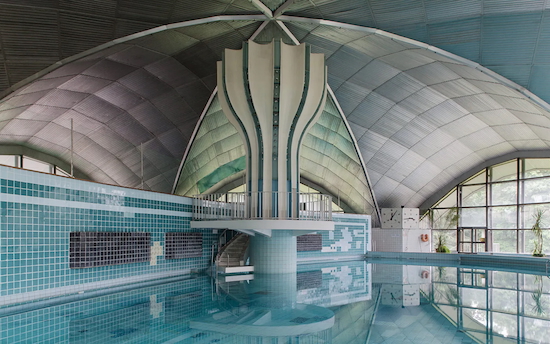
IMAGE: Klyazma Sanatorium, Moscow, 1963.
To see The New Centre Refund Policy CLICK HERE.
To see The New Centre Refund Policy CLICK HERE.