 Cart
CartThe Labor Theory of Life:
Capitalism in the Web of Life Revisited Instructor: Jason Moore Date & Time: February 21, 28, March 7, 14 14:00-16:30 ET
DESCRIPTION: Upon its publication in 2015, Capitalism in the Web of Life reconceptualized capitalism as a world-ecology of power, profit and life, sparking widespread conversations and critiques on the academic left. In this four-session Seminar, we revisit the book to elaborate three key conceptual innovations that have built upon its historical and theoretical architecture over the past decade, foregrounding the labor theory of life. First, Marx and Engels’ historical materialism departs from a critique of “abstract man” and “abstract nature,” centering instead on the labor process as the pivotal relation that simultaneously unfolds between humans—and with the rest of nature. Such a labor-metabolic approach—“labor created man” (Engels)—lays the groundwork for conceptualization of the class struggle in the web of life, an irreducibly socio-metabolic contradiction. Second, the critique of Man/Nature dualism is fundamentally a critique of ideology, underscoring its central role in imperialism through Civilizing Projects from Columbus to the Washington Consensus. This ideological framework has enabled the capricious and epoch-making (extra-economic) appropriation and (economic) exploitation that underwrites endless accumulation. Third, the origins of the climate crisis are rooted in the worldwide class formation that began after 1492, during Marx’s era of so-called primitive accumulation. This historical account traces how early capitalist enclosures and expropriations initiated planetary-scale ecological disruptions, forging fresh connections with contemporary class struggles amid escalating climate crises, and opening avenues for revolutionary strategies.
Session 1, Toward a Labor Theory of Life: An introduction to historical materialism through Marx and Engels, focusing on labor’s transformative role in human-nature relations and the foundations of a labor theory of life.
Readings: Engels, “The Part Played by Labour in the Transition from Ape to Man” (in Dialectics of Nature); Marx, Critique of the Gotha Programme; Marx & Engels, The German Ideology (Part I); Marx, Capital vol. 1 (selections: “The Working Day” and “The General Law of Capitalist Accumulation”); Wittfogel, “Geopolitics, Geographical Materialism and Marxism”; Moore, “Nature and Other Dangerous Words”; Marx, “Theses on Feuerbach”; Marx, Economic and Philosophic Manuscripts of 1844 (excerpts).
Session 2, Imperialism and the Accumulation of Capital: This Session examines capitalism as a world-ecology, focusing on imperialism and mechanisms of capital accumulation that reshape global ecologies.
Readings: Moore, Capitalism in the Web of Life (Chapters 4–6); Luxemburg, The Accumulation of Capital (Chapters 26–29).
Session 3, Ruling Abstractions: We explore the ideological foundations of capitalism’s “civilizing” projects, their environmental impacts, and the concept of bourgeois naturalism through the lens of superexploitation.
Readings: Moore, “Power, Profit & Prometheanism, Part I: Method, Ideology and the Violence of the Civilizing Project”; Moore, “Power, Profit & Prometheanism, Part II: Superexploitation in the Web of Life”; Moore, “Our Capitalogenic World: Climate Crises, Class Politics & the Civilizing Project”; Hage, Is Racism an Environmental Threat? (excerpts); Patel & Moore, “Cheap Nature” in A History of the World in Seven Cheap Things.
Session 4, Climate Crises and Socialist Politics: We connect the climate crisis to socialist strategies, exploring the Anthropocene–Capitalocene debates, revolutionary transitions, and ecologies of revolutionary hope.
Readings: Moore, “The Capitalocene, Part I: On the Nature
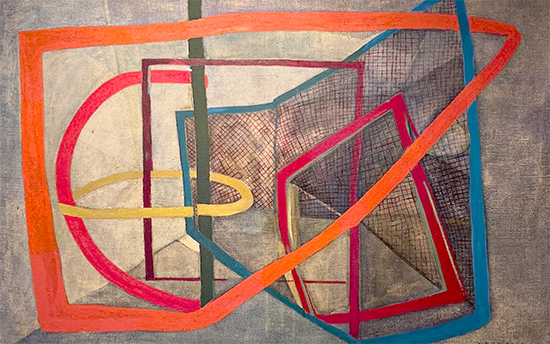
IMAGE: Maria Helena Vieira da Silva, Composition, 1936
To see The New Centre Refund Policy CLICK HERE.
To see The New Centre Refund Policy CLICK HERE.