 Cart
CartMarxism with Chinese Characteristics Instructor: Josef Mahoney Date & Time: October 5, 12, 26, November 2 09:00
DESCRIPTION: Amongst the menagerie of Marxisms past and present, few have been as successful or more misunderstood than Chinese Marxism. Critics have dismissed it as revisionist, anachronistic, exceptionalist, and primitive, and debated its true color. Is it red? Too red? Not red enough? Complicating matters, many who’ve embraced Chinese Marxism or some element therein, e.g., Mao Zedong thought, have too often valorized concepts like class struggle and cultural revolution as universal and transhistorical practices, and even attempted to emulate them in excessive and self-defeating ways. Meanwhile, in China today, Chinese Marxism frequently finds itself reduced in the vernacular of propaganda to a variable but vacuous formalism and an uncontestable state ideology, making it vulnerable to accusations that it exemplifies a reactionary tyranny of the present or perhaps something much worse: empty words.
In a short Seminar like this, it would be a fool’s errand at best to address, one way or another, the multitude of mis-directions or criticisms, whether they’re well-earned or not. Rather, we will elucidate the often overlooked but deep and distinctive foundation in Chinese Marxism that distinguishes it from others. We will focus on the profound influence that traditional thinking continues to have on the development of Chinese Marxism, and likewise the intergenerational continuities from the Mao, Deng, Jiang, Hu, and Xi periods, contrary to frequent depictions of ideological ruptures between them or even wholesale betrayals. We will demonstrate how Chinese Marxism continues to inform China’s strategic worldview and tactical adjustments, including serving as a cornerstone of some of Beijing’s most well-known but least understood policies, including the “socialist market economy,” “one country, two systems,” and “national rejuvenation,” among others, as well as what we’ll describe as China’s “new internationalism,” including new paths for development for emerging economies with programs like the Belt-Road Initiative. Thus, we will explain the significance of Chinese Marxism for the world overall, but especially the Global South, particularly in an era of intersecting singularities associated with the collapse of an American-led global system and the return of a multipolar world, China’s reemergence as a major power and its rise as an advanced technological society amid the onrush of paradigm-shifting technologies, along with the growing pressures to improve governance while fostering green innovation and development to mitigate climate change and black swan events like the recent global pandemic.
Session 1, On Contradiction and Practice: We’ll start by introducing Xi’s concept, “the two combinations,” and what the Chinese call the “Sinicization of Marxism.” We’ll advance via a comparative epistemology, revealing the ideologemes of Western (or) and Chinese (和/and) language and logics. We’ll focus on the “two classics” of Chinese Marxism, Mao’s essays, “On Practice” (1937) and “On Contradiction” (1937), and how his conceptualization of the “unity of opposites” differs from Lenin. We’ll show how these understandings of contradiction have endured to the present, providing the interior logic of many key Chinese policies.
Readings: Kakuzo Okakura, The Book of Tea, Chapter 3; Confucius, Liji/Book of Rites, Book VII, The Li Yun; Laozi, Daodejing, 1; David Hall and Roger Ames, Anticipating China; Mao Zedong, “On Practice,” “On Contradiction;” Josef Stalin, Dialectical and Historical Materialism; Mao, “On the Correct Handling of Contradictions Among the People;” Mao, “Contradictions under Socialism”
Session 2, On Class Struggle and Social Harmony: We begin by discussing the role of class struggle described by Karl Marx and Friedrich Engels, then examine how this concept was instrumentalized tactically by the CPC in different stages of its modern development, including liberation, political consolidation, sovereignty and national rejuvenation, strategic autonomy, the role of technology development, and the struggle against various forms of imperialism and related concerns, like climate change, the struggle between developed and developing countries, the Global North and the Global South, etc.
Readings/Key concepts: Karl Marx and Friedrich Engels, The Communist Manifesto, Chapter 1; Mao, Quotations from Mao Tse-Tung, Chapter 2; Mao, “Where Do Correct Ideas Come From?” Mao, “Talk on Questions of Philosophy;” “Speech By Chairman of the Delegation of the People’s Republic of China, Deng Xiaoping, At the Special Session of the U.N. General Assembly;” Deng Xiaoping, “Address To Officers At the Rank of General and Above In Command of the Troops Enforcing Martial Law In Beijing;” Jiang Zemin on “the three represents;” Hu Jintao on the “harmonious socialist society” and the “scientific development” concepts; Xi Jinping, on “spirit of struggle and daring to struggle/敢于斗争?” and “building a global community of a shared future” (GCSF); Josef Gregory Mahoney, “China’s Rise as an Advanced Technological Society and the Rise of Digital Orientalism.”
Session 3, On Governance: “Governance” has been the keyword of Xi’s “new era” and Xi Jinping Thought, i.e., Xi’s political philosophy as it relates to large-scale issues including national rejuvenation, rural revitalization, party rectification, anti-corruption campaigns, political and governmental reforms, digital governance, international relations, technology, green innovation and development, ecological civilization, peaceful co-existence, the military, and so on. We will discuss the development of governance during Xi’s time in office and how it relates to previous generations, and how Chinese Marxism has been developed in both theory and practice along the way. Also covered, from “serve the people” to “putting people first,” “whole process people’s democracy,” “1-2-3-4-5.”
Readings/Key concepts: Xi, The Governance of China (4 volumes); Chinese Marxism on the xiaokang shehui and establishing a middle income society.
Session 4, On China’s ‘New Internationalism’: China has signaled its rise as a major power in a multipolar world, one in which Chinese Marxism asserts the Five Principles of Peaceful Coexistence, the GCSF, and multilateralism, and actualizes these through the Belt-Road Initiative, the Global Development Initiative, the Global Security Initiative, and the Global Civilization Initiative, along with its support for BRICS, the SCO, the UN, WHO, WTO, and so on. We will examine these developments along with concepts discussed earlier in the Seminar, including building an ecological civilization, the “three worlds theory,” and others. We will look at international security from a Chinese Marxist perspective, including the conflicts in Ukraine, Gaza, and the increasing sensitivity of the polar regions.
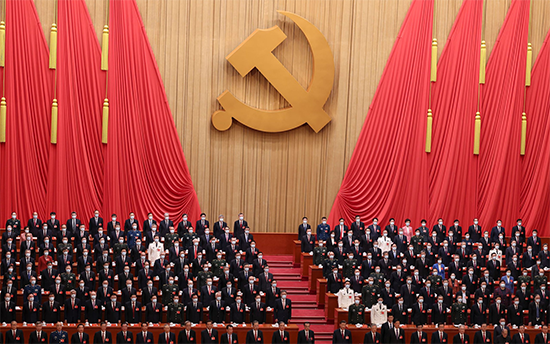
IMAGE: Lintao Zhang, Chinese Communist Party Congress, 2022
To see The New Centre Refund Policy CLICK HERE.
To see The New Centre Refund Policy CLICK HERE.