 Cart
CartReflexive Architecture II :
Seven Continua for the post-digital Instructor: Neil Spiller Date & Time: October 30, 31, November 13, December 4, 18, January 15, 29, February 12, 26 14:00-16:30 ET
DESCRIPTION: Reflexive Architecture is a synthesis between the virtual, the actual, the biological, the cyborgian, the augmented, and the mixed in the context of constructed worlds. Above all, such architectures express the complex entanglement of what Deleuze & Guattari termed “the chaoids or the daughters of chaos: Philosophy, Science, and Art.” It is this transdisciplinary reflexivity that the Reflexive Architecture Workshop explores. The Workshop is structured at a slow-pace with breaks between Sessions to recognize the time participants need to remobilize the concepts discussed for their worldmaking practices.
Participants will be asked to respond to numerous smaller provocations, making works toward a substantial polemical project over the duration of the Workshop. Philosophical and technical workshops facilitate the application of media/software concepts in post-digital worldmaking practices. The Workshop is geared towards those interested in establishing a postgraduate studio practice situated between drawing, modeling, prompting, scripting, coding and both rapid and diegetic prototyping.
The Workshop is split into two strands which run in parallel:
The first, oriented towards architecture’s visionary mode, is set against the backdrop of cybercultural tendencies in reflexive architecture proposed by Neil Spiller in his 2002 issue of Architecture & Design magazine at the millennial turn. This strand includes the exegesis of Spiller’s visionary work Communicating Vessels as well as the works of the AVATAR research group.
Our second strand detours and swerves through the strata of such worldmaking proposed in Derek Hales’ assimilation of the Deleuzian technical object as objectile, offering a philosophical-technical orientation centered on a guided hands-on encounter with software and hardware. We address the rather vexed question of toolsets and technical rigs practically.
While assignments can be completed with mixed-media, simple image-editing tools and a scanner, advanced toolsets and workflows, both closed-and open-source software will be discussed in some considerable detail.
Through our first strand, participants will learn of reflexive architecture as originally pioneered by Spiller in a 7-point manifesto of continua: Space, Technology, Narrative Semiotics and Performance, Cyborgian Geography, Scopic Regimes, Sensitivity, and Time. This visionary orientation features guests with experimental practices relating to the developed themes. The second strand reconstructs this reflexive architectural and cyberspatial proposition after web3 and the cyberphysical, with which the reflexive architectural vision might be actualized anew in a visionary mode of worldmaking and practical engagement in making speculative hard/soft/wet-wares for fictive materialities.
The Workshop offers both an engagement in the construction of media systems and a philosophical engagement in the future of drawing and technical objects. The visionary worldmaking mode will be underpinned by the philosophical development of the Deleuzian concept of objectility, relating it to the process-orientation of Whitehead and Simondon. We will do this by reanimating notions of an analog audio visuality from the practice of Simondon’s construction of a television and Kittler’s building of a synthesizer and loose these amidst the assemblage of digital infrastructures as we reconfigure instances of the seven continua of a post-digital reflexive architecture.
Session 1, 30th and 31st October:
Context: Introducing seven continua for reflexive architecture: Space, Technology, Narrative, Semiotics, and Performance, Cyborgian Geography, Scopic Regimes, Sensitivity, Time.
We will revisit these continua throughout the workshop, conducting philosophical research using mythopoesis (original myth-making through higher imagination) and technogenetics (the intertwined relationship between the origins of humans and technology).
Description: Reflexive Architecture as a technoecological niche
In this Session, we will explore the rapid expansion of web3, XR and AI as a technical assemblage. We will provide a practical introduction to constructing n-dimensional worlds and give an overview of SOTA (state-of-the-art) XR workflows. Participants will begin working with Blender for 3D object-tool production and integrate this within Unity, understanding Unity’s structure and logic for scenographic design in XR events and Blender’s procedural logics.
Pre-requisites:
Install Unity and Blender and Sverchok. We will also offer support for participants seeking to integrate AI into their workflow Claude, Blender-MCP, VSCode, Roo Cline
Tools:
Unity & Blender
Outcome: we examine how surfaces operate in split-site architectures. Rather than treating surfaces as boundaries, we engage them as dynamic, procedural, and sensorial interfaces—capable of encoding feedback, agency, and narrative.Participants will construct procedural surface morphologies in Blender using Sverchok and experiment with surface deformations linked to sensor input. These surfaces will be deployed in Unity environments as if part of reflexive spatial systems. Through this, participants will develop an understanding of surface operations as responsive ‘soft machines’ across multiple continua. The session emphasizes the composition of surfaces not just as geometry, but as responsive diagrams, portals, and mediators.
Session 2, 13th November:
Context: Many areas of architectural experimentation remain underexplored, particularly the surreal processes through which augmented and mixed realities actualize. Spiller’s Communicating Vessels exemplifies the design of relationships across continua. It involves a reflexive relationship with contexts (geographical, psychological, and imagistic), creating worlds that complicate mythopoetic, mythotechnical, and technogenetic narratives. A 15th Century incunabula the Hypnerotomachia Poliphili and an evolutionary tower are introduced.
Description: This session explores how reflexive architecture can be extended through distributed systems as well as systems of optics.
Tools/Platforms: Blender, Unity, Ethereum, MQTT
Outcome: Participants will engage with the notion of ontologies as decentralised constructs—exploring how spatial logic, governance, and agency can be encoded into Web3-native and speculative web 4 infrastructures.
Session 3, 4th December:
Context: This Session presents works exploring reflexive architectural concepts, focusing on the split-site and pataphysical chunking engines. These were deployed in response to perceived problems in architecture and cyberspace around the turn of the millennium. The Session externalizes individual project ideas that Participants can develop further.
Description: Tracing allegorical shadows
Participants will trace found objects using particle systems and generate procedural terrains as allegorical landscapes. They will create scenes within a collective project, map a camera source to an in-world object as a live surface, and explore shadows, optics, movement, and the space between object and surface when split across continua.
Tools: Blender, Unity, Touch Designer, RTML
Outcome: Participants explore the integration of physical-world inputs into virtual reflexive systems, using sensors and real-time data streaming. The goal is to create responsive architectures where physical gestures, movements, or environmental changes influence the form, behaviour, or state of digital models. This builds upon the reflexive surface logics of previous modules, extending them into full feedback loops that incorporate sensor data through OSC and MQTT protocols.
Session 4, 18th December:
Context: In much of late 20th- and early 21st-century digital architecture, technical objects as “objectiles” have often preoccupied form and content over a reflexive pataphysical imagination. In this Session, we prepare for a winter break by discussing creative methodologies for confronting XR continua and remobilizing the objectile across split-sites in speculative hardware, parallel botany and pataphysical computing.
Description: Working with volumes and soft bodies
Participants will work with volumetric approaches and procedural techniques in Blender to generate clouds, fogs, and swarming, soft and fruiting bodies. These assets will be integrated into Unity landscapes.
Tools: Blender, Unity, RTML Touch Designer, Max MSP
Outcome: This concluding technical session synthesises technoecological reflexivity, GenAI form-generation, Web3 governance, and biochemical responsiveness and the speculative terrain of the extraordinary, this session invites participants to construct speculative architectures that think, grow, or metabolise—responsive to environmental, symbolic, or networked stimuli.
Final Four Sessions
Starting in January 2025, the final four Session are project-based, led by Participants’ research. Rather than concluding with a summary, we will maintain openness to chaos and worldmaking, revisiting Reflexive Architecture’s Seven Continua and the mythopoetic and technogenic processes of worldmaking.
Session 5, 15th January:
Context: This Session centers on encounters with AI and visionary architectural works, constructed in tension with polemical discourse on architectural creativity and imagination. Participants will present their chunking engine prototypes while exploring archives of visionary architecture.
Description: Chunking engines and splatting the split-site
Participants will prepare scanned objects using point-cloud data and manipulate them in Blender using various XR development strategies.
Outcome: Participants will manipulate point-cloud data, understand common problems with Lidar scans, and work with Gaussian splats to extract data from scanned objects.
Session 6, 29th January:
Context: Participants will explore the ambiguous sense of time in their project work and complicate discussions on Reflexive Architecture’s Seven Continua.
Description: Reflexive events across split-sites
Participants will compose multiple scenes in Unity, working with in-world scenes, levels, and reflexive events across continua.
Outcome: Participants will prototype interactions between split-sites across virtual and actual continua.
Session 7, 12th February:
Context: Participants will encounter chaos in this Session, slipping between continua.
Description: Scenes, gates, and mappings across continua
Participants will design complex split-sites in Unity, focusing on object interoperability and real-time generative media systems.
Outcome: Participants will design complex reflexive virtual-actual split-sites
Session 8, 26th February:
The final Session focuses on redesigning reflexive continua, inviting Participants to consider the mythopoetic and technogenic processes in their work considering this a work for other works. The workshop will explore participants worldmaking and the individuation of speculative prototype worlds.
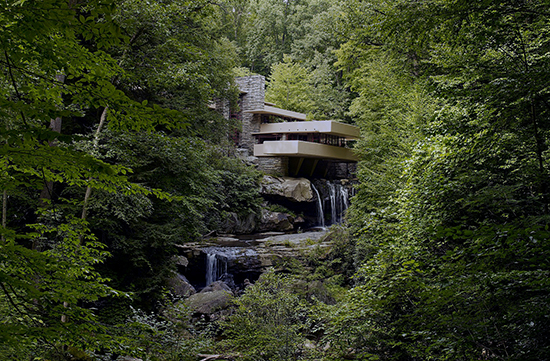
IMAGE: Frank Lloyd Wright, Falling water, 1935.
To see The New Centre Refund Policy CLICK HERE.