 Cart
CartThe Pathos of Modernity Instructor: Nathan Brown Date & Time: November 7, 14, 21, 28 14:00-16:30 ET
DESCRIPTION: In the wake of Kant’s epochal intervention in the history of philosophy and amid the tumultuous aftermath of the French Revolution, a generation of German philosophers and poets took up the task of rethinking knowledge of the absolute, the problem of freedom, the methodology of dialectical reasoning, the concept of the tragic, and, above all, the significance of modernity. The work of Friedrich Hölderlin is central to this pivotal moment in German literature and philosophy in the late 18th and early 19th century. This seminar will focus on Hölderlin’s late Elegies and Hymns, approaching these in light of Hölderlin’s poetological writings and his reception by important twentieth century thinkers (Heidegger, Adorno, Nancy, Hamacher, Henrich). We will play close attention to the formal, conceptual, rhetorical, and tonal particulars of the poems, and we will situate these amid “the pathos of modernity”: the complex feeling of the movement of history as its wrenching transformations traverse modern literature and philosophy.
Each session will focus on one or two poems, but students will benefit from reading widely in Hölderlin’s Selected Poems and Fragments and Essays and Letters. The secondary poems and additional materials listed week-by-week designate particularly relevant selections from Hölderlin and from other sources that may inform our discussions.
Week 1 – Nov. 7
Primary Texts: Bread and Wine; As on a holiday…
Secondary Poems: In Lovely Blue…; The Archipelago
Additional Sources: Nancy, “The Poet’s Calculation”; Hölderlin, “Hölderlin, Essays” “The declining fatherland…” (Coming to Be in Passing Away, p. 271); “When the poet is once in command of the spirit…” (The Procedure of Poetic Spirit, p. 277)
Week 2 – Nov. 14
Primary Text: The Rhine
Secondary Poems: The Ister; Germania; The Traveller; Stuttgart; Homecoming; Rousseau
Additional Sources: Heidegger, Hölderlin’s Hymns: “Germania” and “The Rhine”
Week 3 – Nov. 21
Primary Text: Patmos
Secondary Poems: At the Source of the Danube; The Journey; The Only One (Second Version)
Additional Sources: Revelation (King James Version); Hamacher, “Parousia, Stone Walls”
Week 4 – Nov. 28
Primary Text: Andenken
Secondary Poems: Mnemosyne; Celebration of Peace; Whatever is Nearest
Additional Sources: Heidegger, “Remembrance”; Adorno, “Parataxis”; Henrich, “The Course of Remembrance”
Required Texts
Friedrich Hölderlin, Selected Poems and Fragments, ed. Jeremy Adler, trans. Michael Hamburger, New York: Penguin, 1998.
Friedrich Hölderlin, Essays and Letters, ed. and trans. Jeremy Adler and Charlie Louth, New York: Penguin, 2009.
Additional Sources
Theodor W. Adorno, “Parataxis: On Hölderlin’s Late Poetry” in Notes to Literature, trans. Shierry Weber Nicholsen, ed. Rolf Tiedemann, New York: Columbia University Press, 1991.
Hamacher, Werner, “Parousia, Stone Walls: Mediacy and Temporality, Late Hölderlin” in Two Studies of Friedrich Hölderlin, trans. Anthony Curtis Adler, ed. Peter Fenves and Julia Ng, Stanford: Stanford University Press, 2020.
Heidegger, Martin, Hölderlin’s Hymns: “Germania” and “The Rhine”, trans. William McNeill and Julia Ireland, Bloomington: Indiana University Press, 2014.
Heidegger, Martin, “Remembrance” in Elucidations of Hölderlin’s Poetry, trans. Keither Hoeller, Amherst: Humanity Books, 2000.
Henrich, Dieter, “The Course of Remembrance” in The Course of Remembrance and other Essays on Hölderlin, ed. Eckart Förster, Stanford: Stanford University Press, 1997.
Nancy, Jean-Luc, “The Poet’s Calculation” in Expectation: Philosophy, Literature, trans. Robert Bononno, New York: Fordham, 2018.
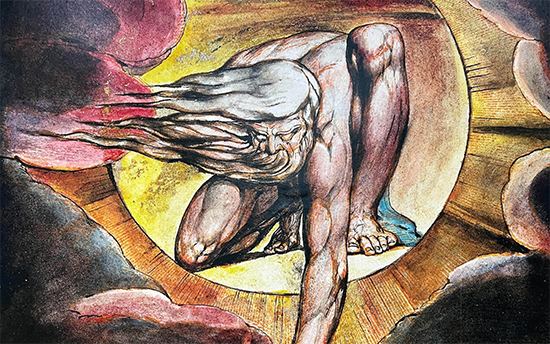
IMAGE: William Blake, The Ancient of Days, 1794
To see The New Centre Refund Policy CLICK HERE.
To see The New Centre Refund Policy CLICK HERE.